

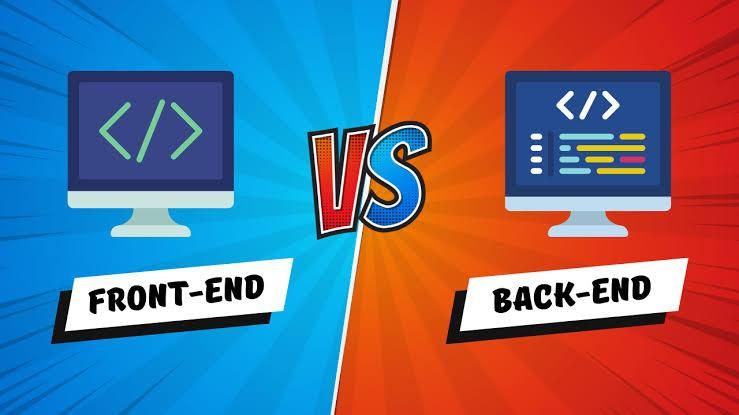

If you are planning to start a career in web development, one of the first decisions you will face is whether to learn frontend or backend development.
Both are important parts of building websites and web applications, but they involve different skills, tools, and responsibilities. Understanding the difference can help you choose a path that matches your interests and long-term goals.
The good news is that you don't need to master everything at once. You can start with one area, build your skills, and explore the other as you gain experience.
What Is Frontend Development?
Frontend development focuses on the part of a website that users see and interact with. It includes the layout, colours, buttons, navigation menus, forms, animations, and other visual elements.
Whenever you visit a website and click a button, open a menu, or fill out a form, you are interacting with its frontend.
Frontend developers use three core technologies:
-
HTML: Defines the structure of a webpage.
-
CSS: Controls the appearance, layout, and design.
-
JavaScript: Adds functionality and interactive features.
As you progress, you can explore tools and frameworks such as React, Next.js, and Tailwind CSS.
Frontend development is a good choice if you enjoy designing interfaces, solving visual problems, and creating experiences that people can easily use.
What Is Backend Development?
Backend development focuses on the systems that operate behind the scenes. It handles the logic, data processing, authentication, databases, and communication between different parts of an application.
For example, when you sign in to a social media platform, the backend helps verify your account, retrieve your information, and deliver the appropriate data.
Backend developers commonly work with technologies such as:
-
PHP: Widely used for websites and server-side applications.
-
Python: Useful for backend development, automation, and other programming tasks.
-
JavaScript with Node.js: Allows developers to build server-side applications using JavaScript.
-
SQL and databases: Used to store, retrieve, and manage information.
Backend development may be a better fit if you enjoy logical thinking, data management, system design, and solving problems that users don't necessarily see.
Frontend vs Backend Development: Key Differences
Although both fields contribute to building functional websites, their day-to-day responsibilities differ.
Frontend development focuses on the user interface, responsiveness, accessibility, and browser interactions.
Backend development focuses on server-side logic, databases, authentication, APIs, and application security.
Frontend developers make sure a website looks and feels right. Backend developers make sure its underlying systems work correctly.
However, these responsibilities often overlap. Frontend developers need to understand how APIs work, while backend developers benefit from understanding how their systems support the user experience.
Which Is Easier for Beginners?
For many beginners, frontend development is a more approachable starting point because you can write HTML and CSS and immediately see the results in a browser.
You can begin with a simple webpage, improve its design, and gradually introduce JavaScript to make it interactive. This immediate feedback can make learning more engaging.
Backend development may feel more challenging initially because it introduces concepts such as servers, databases, authentication, and application logic.
That doesn't mean backend development is too difficult for beginners. With a structured learning plan and consistent practice, you can learn it step by step.
The best starting point depends on how you prefer to learn and the types of problems you enjoy solving.
Which Has Better Career Opportunities?
Both frontend and backend developers can build rewarding careers. Opportunities exist in software companies, startups, agencies, financial technology, e-commerce, and other industries.
Frontend developers can work on business websites, dashboards, web applications, and user interfaces. Backend developers can build APIs, payment systems, databases, and the infrastructure that powers digital products.
Earning potential depends on several factors, including your technical skills, experience, location, portfolio, and ability to solve real business problems. Neither path automatically guarantees a higher salary or a job.
Instead of choosing based only on what appears more profitable, focus on developing skills that employers and clients need.
Can You Learn Frontend and Backend Development Together?
Yes, but it is usually more effective to learn them in stages rather than trying to master both from the beginning.
Start with HTML, CSS, and JavaScript. Build a few small projects, such as a personal portfolio, a landing page, or a simple calculator. Once you understand the fundamentals, you can explore backend programming and databases.
Eventually, you can combine both skill sets to become a full-stack developer.
Full-stack developers work across frontend and backend technologies. This can be useful when building complete applications independently or collaborating with a team.
However, becoming a full-stack developer doesn't mean you must know every programming language or framework. It means you understand how the different parts of an application work together and can build useful solutions.
How to Choose the Right Path for You
Before deciding, consider the type of work that interests you most.
Choose frontend development if you enjoy visual design, interactive interfaces, and seeing your work directly in the browser.
Choose backend development if you prefer working with data, application logic, databases, and server-side systems.
If you are unsure, begin with frontend fundamentals. Learning HTML, CSS, and JavaScript gives you a practical introduction to programming and helps you understand how websites work. You can then decide whether to continue with frontend or explore backend development.
Whichever path you choose, practise by building projects instead of relying entirely on tutorials. Projects help you apply what you learn, identify gaps in your knowledge, and demonstrate your abilities to potential employers or clients.
Final Thoughts
Frontend and backend development are two different paths toward the same goal: building useful digital products.
You don't need to know which path will define your entire career before you begin. What matters most is starting, learning the fundamentals, and gaining practical experience.
Choose one area, remain consistent, and give yourself time to improve. As your knowledge grows, you will be in a better position to decide whether to specialise or expand into full-stack development.
Your journey into tech doesn't have to be perfect. It just has to begin.