


Solution Hub Groups Pages Market Events Blogs Funding Offers Jobs Courses Movies Games Merits
 Terms and Conditions
 Legal & Business Law Agreement
 Child Safety & Policy
 App Installation Guide
 User Guide Page
 Investors & Partnership agreement
 Flowisetech ambassador policy
 About Us
 Flowisetech Earning Guide
 Terms of Use
 Privacy Policy
 Help
Help
 FAQs
FAQs
 Community Guidelines
 Our Purpose
 Withdrawal Terms
 Verification Terms
 Community Policy
Detector IA: The Smart Way to Verify AI-Generated Content in 2026
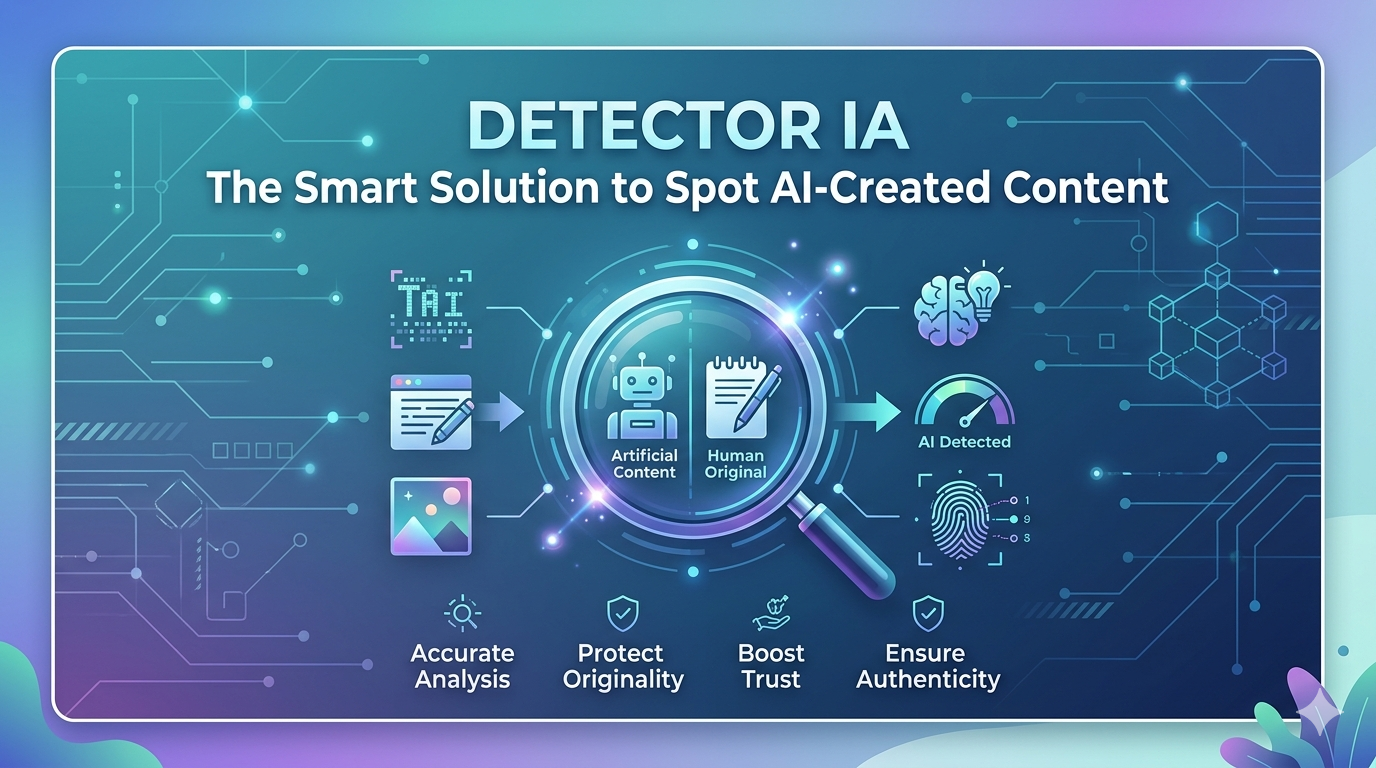
The rapid growth of artificial intelligence has transformed how people create content for websites, blogs, businesses, and education. AI writing tools can generate articles, emails, product descriptions, and marketing copy within seconds. While this technology saves time, it also raises an important question: How can you tell whether content was written by a person or generated by AI?
This is where a detector IA becomes an essential tool. It helps identify writing patterns that may indicate artificial intelligence involvement, allowing users to evaluate content before publishing, submitting, or sharing it.
What Is a Detector IA?
A detector IA is a specialized software designed to analyze text and estimate whether it was created by artificial intelligence or written by a human. Instead of simply searching for copied content, these tools examine writing style, sentence structure, vocabulary distribution, repetition, and language patterns.
Unlike traditional plagiarism checkers, a detector IA focuses on recognizing characteristics commonly found in AI-generated text. This makes it valuable for educators, publishers, marketers, recruiters, and businesses that want authentic written material.
Why Are Detector IA Tools Becoming More Popular?
AI writing technology is improving every day, making it increasingly difficult to distinguish between machine-generated and human-written content. As a result, many industries now use detector IA software to support quality control.
Common reasons include:
-
Maintaining original website content
-
Reviewing academic assignments
-
Checking freelance writing submissions
-
Improving editorial standards
-
Protecting brand credibility
-
Verifying business documents
As digital publishing continues to grow, reliable content verification has become more important than ever.
How Does a Detector IA Work?
Most detector IA platforms rely on advanced machine learning models trained to recognize differences between human writing and AI-generated text.
The process generally includes:
-
Reading the submitted content.
-
Analyzing sentence complexity and variation.
-
Measuring word selection patterns.
-
Identifying repetitive structures.
-
Calculating the probability that AI assisted in creating the content.
Rather than giving a simple yes-or-no answer, many tools provide a confidence score that helps users understand the likelihood of AI involvement.
Benefits of Using a Detector IA
Using a detector IA offers several advantages for individuals and organizations.
Better Content Quality
Editors can review articles before publication to ensure they maintain a natural writing style and consistent tone.
Improved Academic Integrity
Teachers and universities can evaluate assignments more effectively while encouraging students to develop genuine writing skills.
Stronger SEO Performance
Search engines prioritize valuable, helpful, and user-focused content. Reviewing articles with a detector IA helps publishers identify overly robotic writing and improve readability before publishing.
Increased Trust
Businesses can verify important documents and marketing materials, ensuring communication feels authentic and professional.
Who Can Benefit from a Detector IA?
Detector IA tools serve many different users across various industries.
Content Writers
Professional writers can evaluate their work to ensure it sounds natural and engaging.
Digital Marketing Agencies
Marketing teams can maintain high editorial standards while producing large volumes of content.
Students
Students can check whether AI-assisted writing may appear overly machine-generated before submitting assignments.
Website Owners
Blog owners and publishers can review articles to improve originality and create better user experiences.
Businesses
Companies producing reports, newsletters, or promotional content can verify writing quality before distribution.
Features to Look for in a Detector IA
Not every detector IA offers the same capabilities. Choosing the right tool depends on your needs.
Important features include:
-
Fast text analysis
-
Detailed AI probability reports
-
Easy-to-understand scoring
-
Support for multiple languages
-
Secure document processing
-
User-friendly interface
-
Regular algorithm updates
-
High accuracy levels
These features make the verification process faster and more reliable.
Can a Detector IA Guarantee Perfect Accuracy?
No detector IA can promise 100% accuracy. AI writing models continue evolving, and human writing styles vary significantly from person to person.
For this reason, detector results should be treated as helpful indicators rather than final judgments. The best approach combines AI detection with human review to evaluate context, writing quality, and overall authenticity.
Best Practices When Using a Detector IA
To achieve more reliable results, follow a few simple recommendations:
-
Review complete articles instead of isolated paragraphs.
-
Avoid relying on one score alone.
-
Edit repetitive or unnatural sections.
-
Combine detector results with manual proofreading.
-
Focus on improving clarity and reader value.
Using these practices creates stronger, more trustworthy content.
The Future of Detector IA
As artificial intelligence becomes a standard part of content creation, detector IA technology will continue advancing alongside it. Future systems are expected to offer deeper language analysis, improved multilingual support, and more accurate detection methods for increasingly sophisticated AI models.
Rather than replacing human editors, detector IA solutions will work as intelligent assistants that help maintain transparency, originality, and high-quality communication across the digital world.
Conclusion
A KI detector has become an important resource for anyone working with digital content. Whether you are a writer, educator, marketer, student, or business owner, these tools provide valuable insights into the authenticity of written material.
While no detection system is flawless, combining detector IA technology with careful human editing leads to more natural, trustworthy, and engaging content. As AI continues to shape online communication, using reliable verification tools will remain an essential step toward maintaining quality and credibility.

Categories
- Make Money
- Product Review
- Social Media
- Excel
- Graphics design
- Freelancing/Consulting
- E-commerce and Digital Marketing
- Business
- Self Development
- Tips to Success
- Video Editing
- Photo Editing
- Website Promotion
- YouTube
- Computer
- Phone
- Music
- Spirituality & Faith
- School
- Tech & Digital
- Gaming
- News
- Digital Economy / Technology
- Relationship
- Real Estate
- Creative Arts & Design
- Medical
- Causes
- Networking
Read More
Improving your mental health doesn’t require hours of effort. Small, consistent actions—done in just 10 minutes a day—can make a big difference in reducing stress, increasing focus, and boosting happiness. 10-Minute Daily Habits for Better Mental Health Mindful Breathing or Meditation – Spend 10 minutes focusing on your breath to calm your mind. Gratitude...

The global boron minerals industry continues to expand as manufacturers increase the use of boron-based materials across construction, agriculture, glass manufacturing, detergents, ceramics, and specialty chemicals. Colemanite and hydroboracite are naturally occurring borate minerals that serve as valuable raw materials for producing boric acid, borax, fiberglass, ceramic...

Does AT&T own BellSouth today? Learn how BellSouth became part of AT&T and what that means for BellSouth.net email users. Call +1-888-449-5016 or 1-800-288-2020 (Toll-Free) for assistance. For many longtime internet users, BellSouth remains a familiar name, especially for those who still use a @bellsouth.net email address. One of the most common questions people ask today is: Is...

Database design and modeling involve creating a structured framework for storing and organizing data. Here are some key concepts and steps in the process: Requirements Gathering: Understand the data needs of the application or organization. This involves discussing with stakeholders to identify what data needs to be stored and how it will be used. Conceptual Design: Create a...

When Access Is Everywhere but Direction Is Missing We live in the most connected era in human history.Information is instant. People are one click away. Opportunities are online. Yet, more young people feel confused, overwhelmed, and directionless than ever before. This is the paradox of the connected world: access increased, clarity didn’t. Connection Without Direction The...