


Solution Hub Groups Pages Market Events Blogs Funding Offers Jobs Courses Movies Games Merits
 Terms and Conditions
 Legal & Business Law Agreement
 Child Safety & Policy
 App Installation Guide
 User Guide Page
 Investors & Partnership agreement
 Flowisetech ambassador policy
 About Us
 Flowisetech Earning Guide
 Terms of Use
 Privacy Policy
 Help
Help
 FAQs
FAQs
 Community Guidelines
 Our Purpose
 Withdrawal Terms
 Verification Terms
 Community Policy
Stop Chasing Job Titles and Start Building Real Value
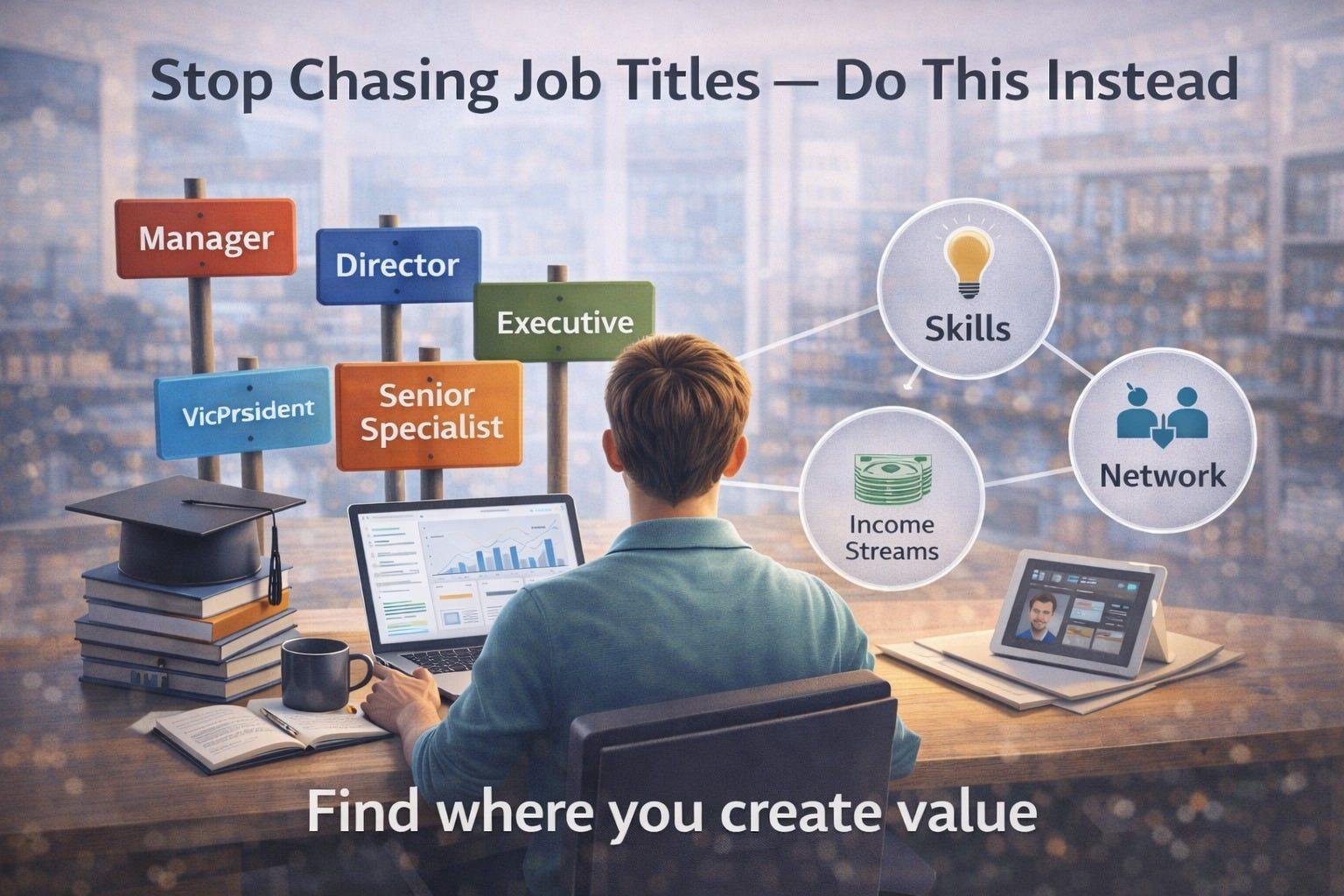
In today’s competitive professional world, it is easy to become obsessed with job titles. People want to become managers, executives, directors, senior developers, consultants, founders, and other professionals with impressive titles. There is nothing wrong with ambition, but the problem begins when the title becomes more important than the value behind it. A title can describe your position, but it does not automatically define your impact. You can have an impressive title and still struggle to solve meaningful problems, while someone with a modest title may be developing valuable skills, creating solutions, serving customers, building products, and becoming increasingly important to an organization or industry.
The more important question is not, “What title do I have?” It is, “What can I do that creates meaningful value?”
Job titles are often temporary. They can change when you move from one company to another, take on new responsibilities, start a business, or change careers. You might be called a junior developer in one organization, a software engineer in another, and a technical lead somewhere else. The title changes, but your underlying skills, knowledge, experience, reputation, and ability to solve problems remain yours. That is why your professional development should not depend entirely on receiving a better title. Instead, focus on becoming more capable and more valuable.
Rather than constantly asking, “When will I get promoted?”, ask yourself, “What capability do I need to develop to become ready for greater responsibility?” That question changes your approach to work. If you are a developer, become better at building reliable systems. If you are a designer, become better at creating experiences that solve real problems. If you work in sales, learn how to understand customers and generate measurable results. If you work in marketing, learn how to turn attention into business outcomes. If you are an employee, understand the problems your organization is trying to solve and become someone who can help solve them.
The goal is not simply to occupy a higher position. The goal is to become capable of handling greater responsibility.
The market does not reward effort alone. It rewards useful outcomes. You can spend years describing yourself as hardworking, but your professional value becomes clearer when your work produces results. This is why skills matter. Learn skills that allow you to solve problems. Learn how businesses operate. Learn how customers think. Learn how to communicate, sell, analyze information, use technology, manage projects, build systems, and work effectively with people. Most importantly, learn how to turn what you know into something useful. Knowledge becomes significantly more valuable when it can be applied.
One of the strongest ways to demonstrate value is to build evidence of your ability. Do not only say that you know HTML, CSS, and JavaScript—build websites. Do not only say that you understand business—improve a business process or build something of your own. Do not only say that you understand marketing—create campaigns and measure their results. Do not only say that you are interested in technology—build useful software. Do not only say that you are a writer—publish valuable articles. Your portfolio tells a story. It demonstrates what you have learned, what you can create, what problems you have solved, and how you have developed over time.
Your reputation also matters. Try to become known for solving something. When people think about a particular problem, you want your name to eventually become associated with the solution. You might become known for building websites, analyzing data, creating content, improving business operations, developing software, selling products, or helping people learn. Authority is not built simply by announcing that you are an expert. It is built by repeatedly demonstrating useful knowledge and producing meaningful results.
Do not wait for your organization to create every opportunity for you. You can learn independently, build personal projects, publish your work, study successful businesses, contribute to open-source projects, create content, solve problems around you, and develop skills beyond your formal job description. Your current position does not have to become the boundary of your ambition.
A valuable professional also learns to focus on problems rather than positions. Instead of asking only what your job requires you to do, ask why the work matters. Look for inefficient processes and think about how they can be improved. Notice customers struggling with something and think about how their experience can be made better. Identify repetitive tasks and consider how they could be simplified or automated. When you understand the larger problem behind your work, you can begin contributing at a much higher level.
Your professional reputation is another asset worth building. It develops through consistent actions: doing excellent work, meeting deadlines, keeping your word, communicating clearly, taking responsibility, helping others, sharing useful knowledge, solving difficult problems, and continuing to learn. Over time, these behaviors create trust. Trust creates opportunities. A person with a strong reputation does not always need to chase opportunities because people begin to seek them out for their skills and reliability.
Measure your growth by capability, not only by title or salary. Ask yourself, “What can I do today that I could not do one year ago?” What problems can you solve now? How much responsibility can you handle? What results have you produced? What skills have you developed? What have you built? Who benefits from your work? These questions provide a much clearer picture of professional development. A title may tell people where you sit on an organizational chart, but your capabilities tell them what you can actually do.
Money also matters, but sustainable earning power is closely connected to the value you can create and communicate. As you become better at solving valuable problems, your opportunities can expand. You may qualify for greater responsibilities, negotiate better compensation, attract clients, build products, teach others, or create additional sources of income. The goal is not to chase money blindly. Build valuable capabilities, apply them to meaningful problems, produce results, and learn how to communicate those results effectively.
Your career is also bigger than your current job. Your skills, personal projects, relationships, knowledge, reputation, and experiences all contribute to your long-term professional capital. Think beyond your current employer, title, and salary. Ask yourself what you are building that could remain valuable five or ten years from now. It could be a technical skill, a professional reputation, a portfolio, a network, intellectual property, a business, or a body of knowledge. Build assets that remain useful even when your circumstances change.
There is a difference between appearing successful and becoming valuable. A title can make you look successful, but a valuable skill makes you useful. A certificate can show that you completed something, but a portfolio can demonstrate what you can actually do. A position can give you authority, but competence can give you influence. Recognition can make people notice you, but consistent results can make people trust you.
Do not spend your entire career trying to look important. Spend it becoming capable. Learn. Build. Solve. Create. Improve. Serve. Document your results. Keep developing. The more value you can create, the less dependent you become on a title to prove your worth.
Eventually, the question will not simply be, “What is your title?” People will want to know, “What can you do?” That is a much more powerful question to be able to answer.
Stop chasing the title. Start building the value that makes greater opportunities possible.
Categories
- Make Money
- Product Review
- Social Media
- Excel
- Graphics design
- Freelancing/Consulting
- E-commerce and Digital Marketing
- Business
- Self Development
- Tips to Success
- Video Editing
- Photo Editing
- Website Promotion
- YouTube
- Computer
- Phone
- Music
- Spirituality & Faith
- School
- Tech & Digital
- Gaming
- News
- Digital Economy / Technology
- Relationship
- Real Estate
- Creative Arts & Design
- Medical
- Causes
- Networking
Read More
Embroidery has become a popular way to decorate uniforms, hats, jackets, bags, and many other products. A beautiful embroidered design does not happen by chance. It starts with a well-made stitch file. The quality of the stitch file decides how the final embroidery will look on the fabric. If the file is clean and accurate, the design will stitch smoothly and look professional. Many businesses...

When most people hear the word blockchain, their minds immediately jump to cryptocurrencies like Bitcoin and Ethereum. For years, digital currencies have dominated conversations around blockchain technology, creating the impression that blockchain exists solely to power financial transactions. However, the true potential of blockchain extends far beyond cryptocurrency. In fact, some of...

Choosing a skill to learn online should be an exciting step toward personal growth and new opportunities. Unfortunately, many beginners make decisions based on emotions, trends, or misinformation rather than careful planning. As a result, they waste time, lose motivation, and often conclude that online learning "doesn't work." In reality, the problem usually isn't the skill itself—it's...
A Complete Guide to the Modern Standard of Web Development When people begin learning web development, one of the first terms they encounter is HTML5. You'll see it mentioned in tutorials, documentation, job descriptions, and almost every modern website. But what exactly is HTML5? Is it a new programming language? How is it different from HTML? And why is it still important in 2026? The...

Football is one of the most popular sports in the world, attracting millions of fans every day. Along with the excitement of each match, many people also like to follow football betting odds to better understand market trends and compare match expectations. Having access to accurate, updated, and organized information makes this process much easier. https://keonhacai58.in/ is a website...